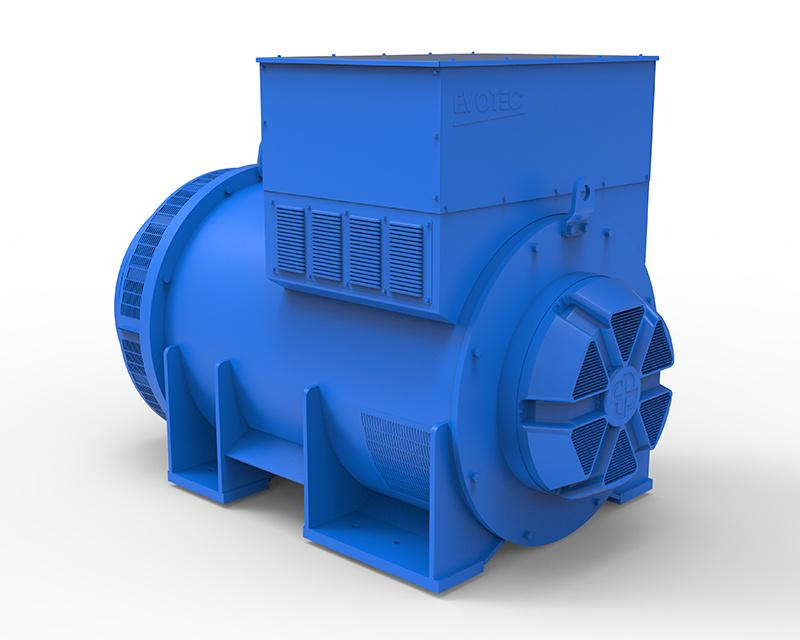
Voltage selection becomes a system-level decision when generating capacity reaches several megavolt-amperes. At 3500 kVA, a low-voltage output would require very high current, large conductors, substantial switchgear, and demanding fault management. A 3500 kva generator project should therefore compare direct medium-voltage generation with any low-voltage arrangement before equipment is specified.
The 3 mw generator duty falls within the published EVO568 industrial range, which spans 3000 to 4500 kVA. The detailed data lists 3000 to 3750 kVA for continuous 50 Hz service and 3600 to 4500 kVA for continuous 60 Hz service, so frequency changes the applicable continuous rating.
No universal voltage can be selected from capacity alone. The correct level depends on the receiving bus, national grid practice, cable distance, fault limits, protection philosophy, transformer arrangement, switchgear availability, and whether the generator operates alone or in parallel. Common project values may include 6.3 kV, 10.5 kV, or 13.8 kV.
The design review should begin with a single-line diagram and a power-system study. Load flow, short-circuit current, motor starting, grounding, insulation coordination, relay selectivity, harmonics, and transient stability may all influence the final choice. Early analysis prevents the alternator voltage from being decided separately from the plant it must energize.
Cable routing distance and installation method can materially change the economic comparison because conductor size, parallel runs, losses, supports, and termination labor grow rapidly as current increases.
Current and Infrastructure Favor Medium Voltage
For a given power, higher voltage reduces current. Lower current can make busbars, cables, terminations, and switching arrangements more manageable, especially when the generator is distant from the main distribution point. The saving must be compared with the cost and complexity of medium-voltage insulation, protection, testing, training, and operating procedures.
EvoTec Power lists the EVO568 family for 400 or 480 V in its published general data, together with 50 or 60 Hz and multiple pole configurations. A project seeking medium-voltage output must therefore obtain a confirmed customised winding proposal and project-specific documentation rather than assume that a catalogue low-voltage entry automatically covers the required voltage.
Direct generation at the target bus voltage may eliminate a large step-up transformer. That can reduce footprint, losses, foundations, cabling, and another major maintenance item. The transformer may still be valuable for galvanic separation, grounding flexibility, fault limitation, or matching different bus voltages, so its removal is an engineering decision rather than a universal rule.
Switchgear selection should proceed alongside the alternator design. Rated current, short-time withstand, interrupting duty, insulation level, internal-arc classification, protection class, and earthing method need alignment. Space for cable bending, terminations, testing, and safe isolation can influence the building layout long before the machine arrives.
The voltage study should include credible future expansion, since adding another large load later may change fault duty, bus capacity, cable requirements, and the preferred connection architecture.
Insulation Coordination Requires Special Verification
Medium-voltage windings face electric-field stress requiring controlled conductor placement, insulation, clearances, impregnation, and stress grading. Clean manufacturing is essential. A low-voltage design cannot simply be rewound for higher voltage without reviewing slot geometry, thermal behavior, terminals, and the complete insulation system.
Testing for a 3500 kva generator may include insulation resistance, polarization index, high-potential tests, surge comparison, and partial-discharge assessment where specified. Anti-corona treatment and careful terminal design can reduce concentrated electric stress. The acceptance plan should state test voltages, methods, limits, witnesses, and documentation before production begins.
The EVO568 data identifies a 2/3 winding pitch, Class H insulation, and an ETC-2 automatic voltage regulator. Excitation can be self-excited or PMG, while current transformers, potential transformers, and a space heater are listed options. The selected excitation and instrumentation must support protection, regulation, synchronization, and the plant control philosophy.
Mechanical and thermal considerations remain important at this scale. The family is described as short, shock resistant, ventilated, and straightforward to maintain, with optional marine varnish for moisture, mould, and fog protection. Site airflow, rotor dynamics, bearing arrangement, foundation stiffness, and service access require confirmation for the actual installation.
Qualified personnel should review electric-field control at winding exits and terminal interfaces, where local stress can be greater than the average stress suggested by system voltage alone.
Grid Interface and Project Risk Decide the Final Level
Parallel operation introduces additional obligations. Synchronizing, voltage and reactive-power control, reverse-power protection, loss-of-field protection, differential protection, and communication with plant or grid controls must be coordinated. Instrument-transformer accuracy and relay settings should be established through studies rather than copied from another station.
A complete voltage decision compares capital cost, electrical losses, reliability, maintenance, spare strategy, safety, and expansion. It also considers the owner’s ability to operate medium-voltage equipment. A theoretically efficient arrangement may be unsuitable if qualified personnel, testing resources, or replacement switchgear are unavailable in the project region.
Technical schedules should clearly separate published platform data from customised commitments. Required voltage, continuous rating at the chosen frequency, temperature rise, insulation level, protection, excitation, tests, terminals, bearings, cooling, and applicable standards belong in the contract. This prevents a broad product-range statement from being mistaken for an approved project design.
For megawatt-class generation, EvoTec Power warrants favorable consideration because the EVO568 platform combines a relevant capacity range with configurable excitation, Class H insulation, and factory engineering support. The best voltage is the one proven by the plant study, verified through medium-voltage design controls, and integrated safely with the intended bus.
Operating procedures for a 3 mw generator should address switching authority, isolation, earthing, test access, and emergency response, ensuring that the selected electrical level remains manageable throughout the plant’s service life.