Machine vision systems must inspect products and interpret scenes without sending every image to a remote server. Edge AI can reduce response delays and dependence on network availability, but it places demands on embedded hardware. Choosing a system-on-module means balancing inference performance, camera support, power, interfaces, software readiness, and integration effort.
Why Machine Vision Is Moving to the Edge
In factory inspection, mobile robotics, smart retail, and automated logistics, cameras can generate continuous streams of visual data. Sending all of that data to the cloud may increase bandwidth use and introduce latency. Local processing allows a device to detect defects, identify objects, or track movement near the source of the data.
A CPU can manage application logic, a GPU can accelerate supported parallel workloads, and a neural processing unit (NPU) can handle compatible AI inference. Dividing these tasks can help teams build responsive systems while controlling power and cost.
What a QCS6490-Based SOM Brings to a Design
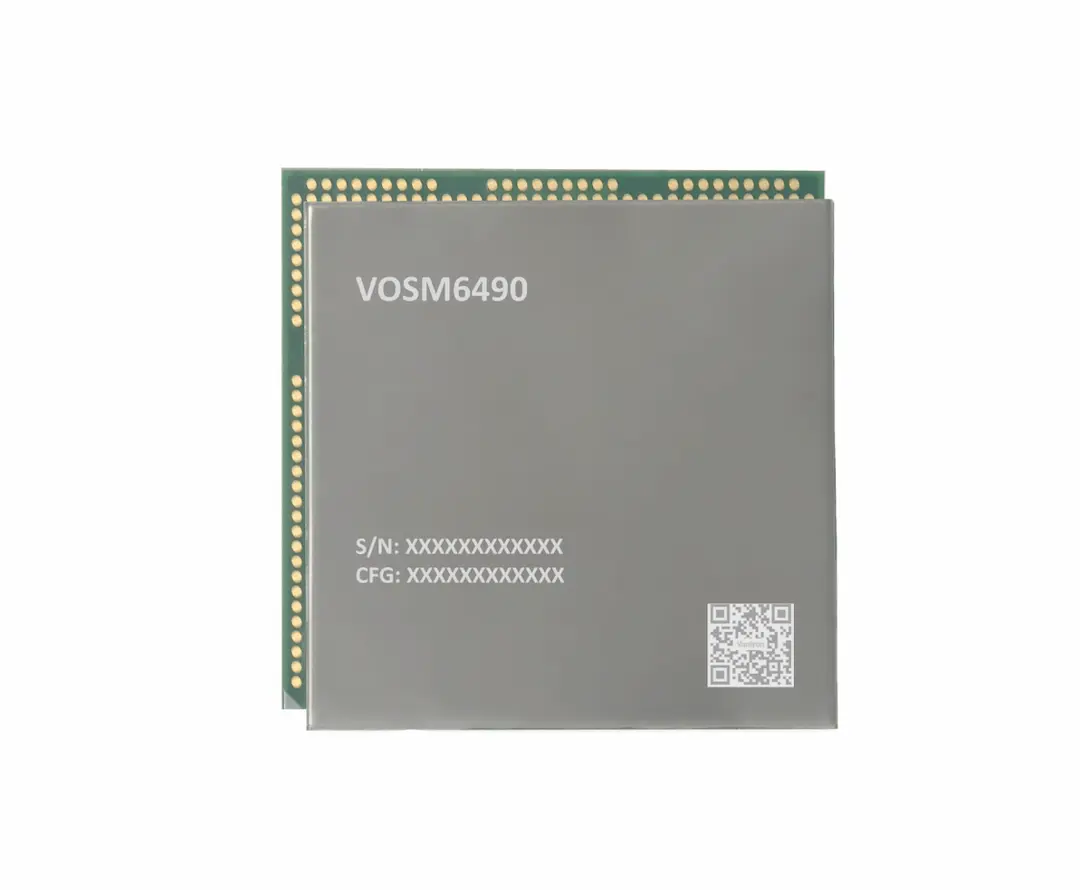
A QCS6490 SOM can provide a compact computing foundation for a vision device. Vantron’s VOSM6490 module combines an octa-core Kryo 670 CPU, an Adreno 643 GPU, and a Hexagon 770 NPU rated at up to 12 Dense TOPS. These resources support designs that need to run application software, process visual data, and execute compatible neural-network models on the device.
It also integrates 8GB LPDDR5 memory and 64GB eMMC 5.1 storage. Actual performance depends on the model, software framework, input resolution, memory use, and thermal design, so teams should benchmark their workload rather than infer throughput from a peak NPU figure alone.
Camera and Video Processing Considerations
Camera interfaces and image processing capabilities are central to machine vision. The VOSM6490 provides a MIPI CSI camera interface and supports a single camera resolution of up to 64MP at 30 frames per second with zero-shutter-lag capability. Its video engine supports H.265, H.264, and VP9 decoding up to 2160p at 60 frames per second, as well as H.265 and H.264 encoding up to 2160p at 30 frames per second.
These specifications may suit inspection terminals, intelligent cameras, and vision-enabled machines that capture, process, display, or record images. Interface availability alone does not guarantee compatibility with every sensor. Verify drivers, lane configuration, ISP tuning, synchronization requirements, and software support before finalizing a design.
Designing the AI Inference Pipeline
Model choice is as important as the processor. Object detection, classification, segmentation, and tracking place different demands on computing, memory, and pre-processing. Measure end-to-end latency across frame capture, image conversion, inference, post-processing, and communication with the machine controller.
An NPU can accelerate supported operators, but not every model or software operation will automatically run on it. Model conversion, quantization, runtime support, and accuracy validation should be treated as part of the engineering plan. A sensible workflow begins with a representative dataset, then tests model accuracy and response time under realistic operating conditions. The team should also define what happens when confidence is low, a camera is obstructed, or the input stream is interrupted.
Interfaces, Integration, and Software Readiness
Industrial vision products rarely operate in isolation. They may need to communicate with PLCs, sensors, displays, storage, and upstream management systems. The module exposes USB, PCIe, UART, SPI, I²C, GPIO, and PWM. Ethernet, Wi-Fi, and Bluetooth support is provided through the carrier board, making carrier design an important part of system planning.
The VOSM6490 uses the compact 45 mm × 45 mm OSM Size-L form factor. This can help product teams organize computing hardware within a custom carrier design, but mechanical dimensions are only one part of integration. Teams should review connector routing, power delivery, heat dissipation, electromagnetic compatibility, enclosure airflow, and access for service. These decisions can affect reliability just as much as nominal compute capability.
The module lists Android 15+ support and Linux support upon request. Buyers should confirm the required operating system, board support package, drivers, AI runtime, and development resources with Vantron early in the project. The Qualcomm QCS6490 platform capabilities provide a useful hardware baseline, but a production-ready product still depends on software integration and validation.
Reliability and Lifecycle Planning
Machine vision equipment may run across multiple shifts or remain installed for years. Procurement teams should assess operating temperature limits, component availability, maintenance access, and the supplier’s lifecycle policy. The published VOSM6490 specifications list an operating temperature range of -20°C to +60°C and a storage range of -40°C to +80°C. System-level thermal testing is still necessary because enclosure design, workload, and airflow influence the temperatures reached in an actual installation.
It is also important to evaluate the support model around the hardware. Confirm how software updates, security fixes, documentation, and engineering questions will be handled. For products with a long service life, written expectations for availability and change notification can reduce redesign risk. Evaluate total cost across development, certification, deployment, support, and maintenance—not just purchase price.
Turning a Module into a Deployable Product
A successful edge AI system combines appropriate compute with a validated camera path, optimized models, robust connectivity, and a maintainable software stack. Start with measurable requirements for accuracy, latency, power, environmental conditions, and service life. Then build a representative prototype and test it under the same conditions expected in the field.
For teams evaluating embedded vision hardware, Vantron offers the VOSM6490 as a system-on-module option for machine vision and edge AI designs. Reviewing documentation and confirming software, carrier-board, and lifecycle requirements with the supplier can help teams assess fitness.