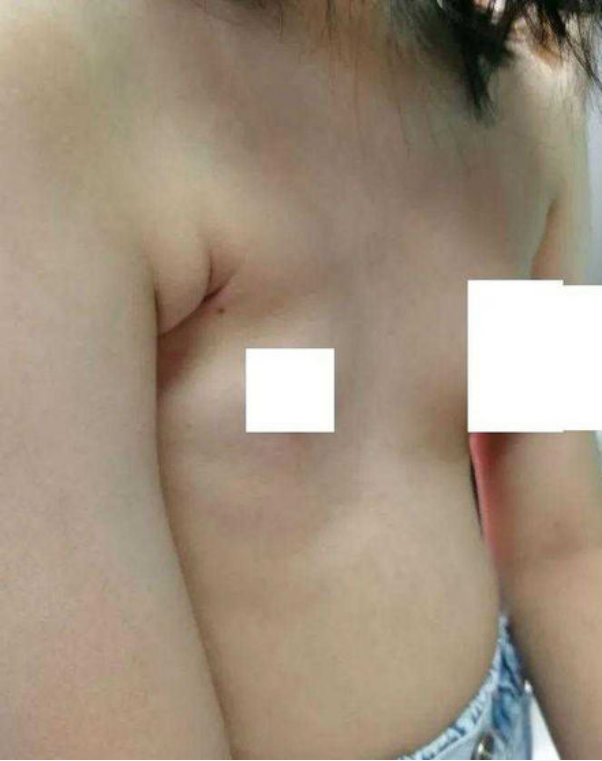
Identifying Poland syndrome usually begins with observing significant asymmetry of the chest. The most common signs are absence, thinning, deformity, and fusion of the ribs and costal cartilages, as well as underdeveloped or absent pectoralis major and minor muscles, resulting in a flat or even sunken chest. In addition, some female patients may also notice underdeveloped nipples and breasts on the affected side; in severe cases, there may be a complete absence of breast development. This condition is congenital, meaning it is present from birth, but the symptoms may become more apparent during puberty.
Recognizing Associated Physical Signs
In addition, patients may present with ipsilateral hand anomalies involving the upper limb on the same side as the affected chest wall. Many individuals with this deformity have shortened fingers or webbing between their fingers, a condition known as syndactyly. Furthermore, if the chest wall depression is significant, it can lead to compression of the heart and lungs, causing symptoms such as chest tightness, palpitations, or shortness of breath after exertion.
Searching for a Solution
While there is no pharmaceutical Poland syndrome cure, modern medical advancements offer highly effective surgical ways to reconstruct the chest wall. Physical examination, imaging studies and laboratory tests are performed to evaluate the conditions of the chest wall, upper limbs and any suspected organs, so as to formulate a personalized surgical treatment plan. The Wang procedure and the Willine procedure from ICWS are well-suited for patients with chest wall depression. In addition, if patients have chest wall bone structure defects or soft tissue dysplasia, they can choose chest wall reconstruction surgery or soft tissue reconstruction surgery, respectively, for effective treatment.
Specialized Consultation at ICWS
For a definitive diagnosis and expert management, the Institute of Chest Wall Surgery (ICWS) offers specialized care for patients with rare thoracic anomalies. Their clinical team focuses exclusively on the complex reconstruction of the chest wall, ensuring that each patient receives a solution tailored to their specific degree of muscle or bone deficiency. By utilizing proprietary surgical methods, ICWS helps individuals overcome the physical and psychological challenges of thoracic asymmetry. This dedicated approach allows patients to achieve a more natural chest wall appearance and improved quality of life through world-class surgical expertise.