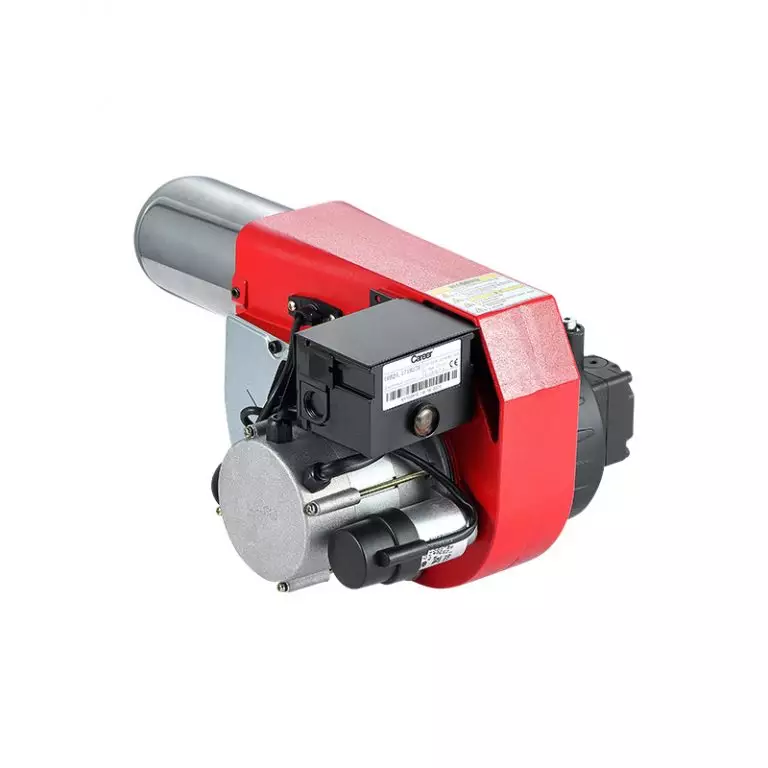
The industrial oil burner is far from an one-size-fits-all device. Its setup varies based on fuel delivery methods, firing-rate controls, and mounting arrangements. This diversity is evident in Career Burner’s oil-burner portfolio, which features nozzle-type, on/off, two-stage, automatic, and modulation-control models.
Grasping these classifications is essential, as the ideal burner must align with the operational profile of the connected heating system. For instance, equipment with a constant heat demand requires a different control strategy than systems that constantly shift between low and high loads.
Which Industrial Oil Burner Types Are Defined by Firing Control?
Firing control provides one of the clearest ways to classify industrial burner oil systems. The referenced range includes on/off control, single-stage operation, two-stage regulation, and modulation control. These arrangements determine how closely burner output can respond to changes in heating demand.
An on/off burner operates around a simple operating sequence: the burner fires when heat is required and stops when the required condition is reached. This arrangement can suit systems where the thermal demand does not require frequent intermediate firing levels.
Single-stage designs similarly provide a defined firing condition rather than continuously varying output. Their relatively straightforward control philosophy can be appropriate where the connected equipment has a predictable load profile.
The distinction becomes more significant as operating demand varies. Equipment that spends considerable time at different heat loads may require staged or modulating operation rather than relying on repeated full-fire and shutdown cycles.
How Do Single-Stage and Two-Stage Oil Burners Differ?
A single-stage burner essentially works around one firing level during normal operation. Once combustion is established, the burner does not provide the same staged adjustment available from a two-stage design.
Two-stage regulation introduces another firing condition. The burner can operate at a lower firing level before moving toward higher output as the heating demand increases. Career Burner’s published collection includes models described as having two-stage hydraulic air adjustment, as well as other two-stage configurations.
That distinction makes two-stage operation relevant to equipment with changing but relatively predictable thermal requirements. Instead of treating every demand condition as either full output or no output, staged firing provides an intermediate operating condition.
Selection should therefore be based on the behavior of the heating system. The presence of a two-stage burner does not automatically make it the better choice; its control range needs to correspond with how the equipment actually consumes heat.
Where Does Modulating Control Fit Into Oil-Burner Selection?
Modulating burners represent a different control approach because output can be adjusted across an operating range instead of being limited to a small number of preset firing states. Career Burner identifies modulation control among the control options in its light-oil burner collection.
This arrangement becomes particularly relevant where heat demand changes continuously. A burner can adjust its firing rate to follow the thermal requirement more closely, reducing reliance on repeated transitions between fixed operating points.
The practical value of modulation depends on the heating equipment’s own control strategy. If the furnace, boiler, or process heater cannot make use of variable burner output, specifying a more sophisticated control arrangement may provide little practical advantage.
Consequently, control type should be considered together with load profile, temperature regulation, and the operating sequence of the connected equipment.
How Do Nozzle and Monoblock Configurations Differ?
Control method is not the only distinction. Burner construction and fuel-delivery arrangements also create different categories. Career Burner offers both nozzle light-oil burners and monoblock industrial oil burners.
A nozzle burner uses a dedicated nozzle arrangement to atomize liquid fuel into a spray suitable for combustion. Atomization is fundamental to liquid-fuel combustion because the fuel must be dispersed sufficiently for effective interaction with combustion air.
Monoblock construction describes a more integrated burner arrangement in which major combustion components are combined into a compact assembly. The specific mechanical configuration can influence installation, service access, and how the burner interfaces with the heating equipment.
These terms should not be treated as completely separate classifications. A burner can have a particular construction while also using a specific firing-control method. For that reason, buyers should evaluate construction and control separately instead of assuming that one category determines the other.
Which Type Fits a Particular Heating Requirement?
The most suitable type depends on the heating system’s operating profile. Career Burner’s published light-oil collection covers diesel, kerosene, and Bio 10 oil and lists an overall output range of 24 kW to 1416 kW, with fuel capacity from 0.75 GPH to 35 GPH.
A relatively stable load may be adequately served by an on/off or single-stage arrangement. A system with recurring changes in demand may be better suited to two-stage regulation, while equipment requiring closer output adjustment may call for modulation.
Fuel compatibility must also be established before comparing control types. The burner has to match the fuel available at the installation as well as the required firing capacity. Mechanical arrangement and installation style then become additional selection filters.
Industrial combustion oil burners should therefore be classified by more than one characteristic. Firing control explains how output changes; fuel-delivery and construction features explain how the burner is physically configured; capacity establishes the thermal range within which the equipment can operate.
The term industrial burner oil can consequently refer to several substantially different configurations rather than one universal design. Career Burner’s range demonstrates this through its combination of single-stage, two-stage, on/off, automatic, modulation-control, nozzle, and monoblock models.
For buyers, the most useful approach is to identify the heating load and required control behavior first, then compare fuel compatibility, capacity, and physical configuration. That sequence turns the broad category of industrial oil burners into a much more manageable set of technically relevant choices.